Once upon a time a long time ago my girl and her bear were separated for a few days and I decided to give Zest a bath, sew up some holes, and renew his stuffing. My good intentions were met with tears! I learned the heartbreaking way (for both of us) that stuffies are more than just stuffies and changes – even improvements – need consent. Perhaps the biggest lesson for me was that the connection between child and stuffie is REALLY important.
Bear before.
Fast forward to now.
I recently read a mom’s plea on our local Facebook chat room asking about a place that repairs stuffies. I felt a calling, so volunteered my services and mom accepted. Based on my earlier experience, I insisted on speaking to the bear owner and we talked about what he wanted done. Ari was very clear, he wanted his bear to be blemish free (no more visible repairs) and he wanted more “beans in his butt.” Can do.
I spent hours removing all the old repairs lovingly made by his mom. The trick is to remove without causing further damage. I used very fine, sharp scissors and tweezers and opened up all the big wounds pulling snipped threads out centimeter by centimeter. Once I could access his insides, I could see he really needed a bath and restuffing. Permission was sought and granted. I still held my breath!
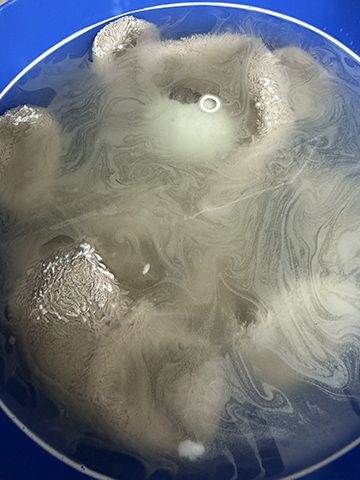
In which Bear gets a bath.
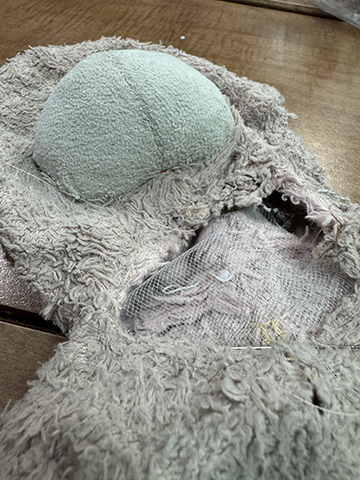
Each hole was backed with netting to prevent further damaging the fur and to help strengthen him for future loving.
Once Bear (for that is his name) was clean, I found more repairs that needed to be removed before I could start work putting him back together. This whole process was guided by my time as a textile specialist volunteer at the Henry Ford Museum. As much care and thought went into this bear as went into the 18th century suit I rebuilt. I used fine tulle to back each of the repaired areas to strengthen the new stitching and help reduce further damage. I dug into my specialty thread for conservation work and found some 100 wt. silk that matched perfectly.
Poor Bear’s fabric has been well loved and is very damaged. There were a lot of holes and seams that had given out. Once holes were fixed, then I could start stuffing. But how much? What was Bear like before? I could only guess. I opted for enough stuffing to allow him to sit properly. After adding a second pouch of beans to help him sit, I filled him up. Now his arms and legs and head don’t droop and he can sit properly like a good bear should.
Bear looks pretty darn good, if I do say so myself!
I spent about 12 hours repairing Bear when I might have been doing class prep or knitting samples. But. It was totally time well spent. I enjoyed seeing Bear return to a serviceable life and was in my happy place with a sewing needle in my hand. Best of all, Ari declared him squishy and gave him a big hug. I think his eyes say it all.
I know I’ve been absent from my blog for too long. Covid stacked up so much on my to-do list that it has been hard to step back and take a breath. Learning video, creating not one, but two webstores (when the first one became inadequate), and generating new classes and patterns has been time consuming. In the last few months, I feel like my nose is popping up above the water line more often and for that I am grateful. Of course, when that happens, the creativity gene reactivates and that is what I wanted to share with you today.
I am building a Weaving Lab in the store. Daryl Lancaster got me thinking about how she uses little looms to demonstrate weaving techniques and my idea grew from there.
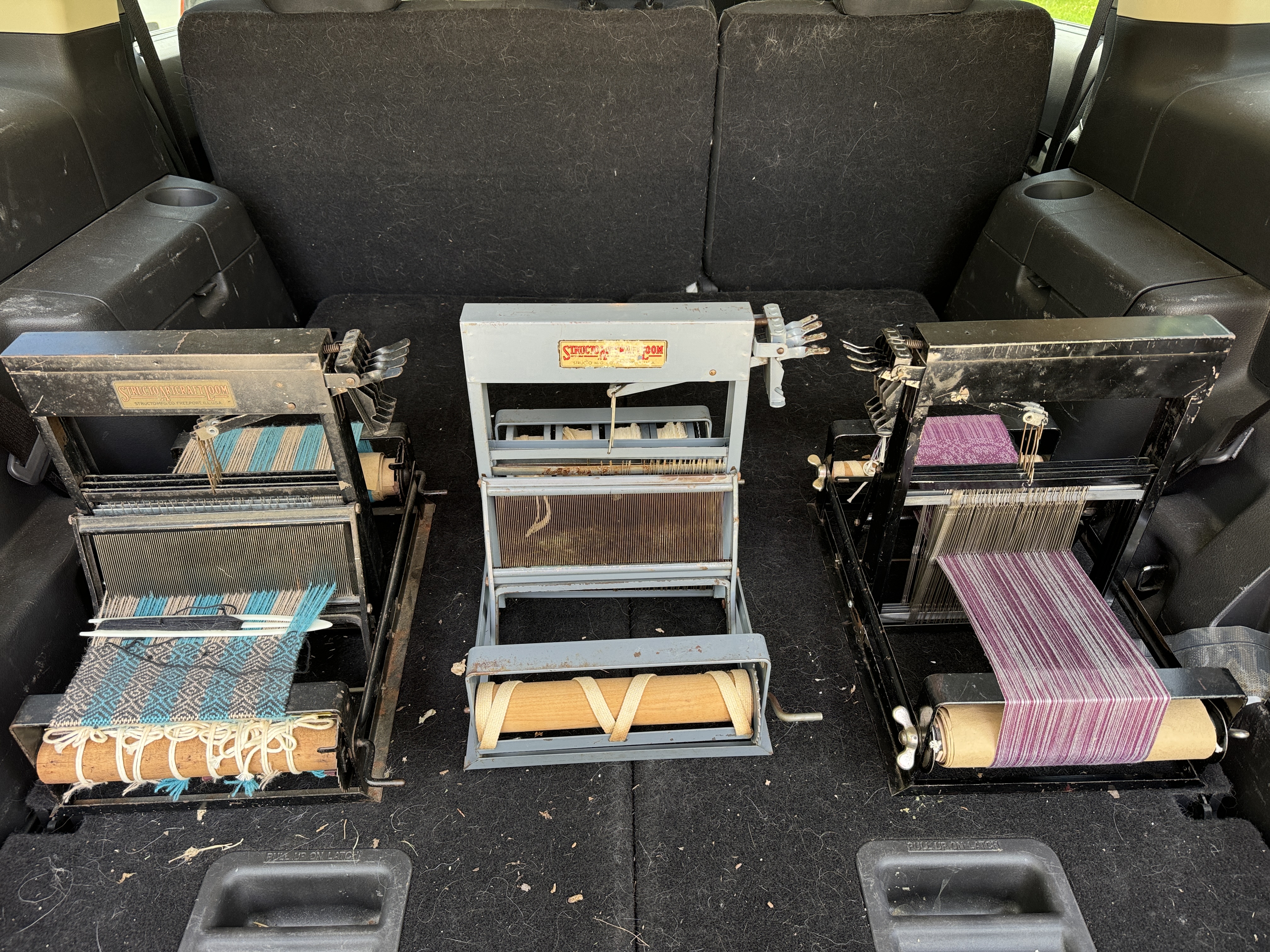
Right now I am in the collecting and rehabbing stage. Dorinda has adopted the rehabbing job and I know it will take many hands to make this dream a reality. Ultimately we will have 14 or 15 table looms plus a rigid heddle and inkle or two that are dressed and ready for the public to weave on. The table looms include fully modern ones like the Louet Jane, Ashford Katie and Leclerc Voyageur, Schacht inkle and rigid heddles, plus antique and vintage metal Structo looms that are 100 years old and newer.
This loom came prewarped with overshot double-weave. So pretty!
The Structo looms, first introduced as toys in 1921 and marketed later to adults until 1981, are perfect for this project. They are affordable (when you can find them) and the majority of the ones I have are 8″ wide. Most are 4-shafts, but some are 8-shafts and some are only 4″ wide. So far we don’t have any 8-shaft looms but we do have a cute little 4″ version. Structo also made wider wood looms (we have one in the family and it is a joy to weave on), but they are too big for the space we have.
Each loom will be dressed with a different weave structure including plain weave, double weave, huck, waffle weave, krokbragd, twills, color and weave, and more. Materials will vary, too — linen, cotton, wool, and silk. Each loom will have written and video instructions and samples with it to guide the user. Weavers will be able to take home a sheet that includes a draft and overview of the technique plus a sample that they have woven. The looms will be available to use anytime we are open and payment will be based on a combination of materials used and pattern complexity. Best of all, no prior weaving experience is necessary, but there will be a recommended weaving order so no one flounders. Obviously, I have some things to figure out. Looms will be added as they are built or refurbished. It is my intension that we have at least a few looms available starting in September.
I am still looking for several more 8″ Structo 240s, both 4 and 8 shaft versions. We gladly accept donations for the good of weaving education, but I am certainly willing to pay a reasonable price to help make this dream come true. If you know of any available, please send the owners my way. Or, if you have one gathering dust, let’s talk!
Three new-to-us looms just added to the Lab.
Impact:
Sometimes knowing the “why” makes a story even better. This project is important to me because the biggest reason I opened Heritage Spinning and Weaving (Lake Orion, Michigan, USA) in 2000 was to provide a learning and gathering place for fiber enthusiasts. Mazlow’s Hierarchy of Needs says the basics have to be covered before you can have the extras. After 25 years of intense fibering and community building, I know we are ready to share our enthusiasm and create opportunities for people of all ages. Inclusivity is very important to us here. Nothing should divide us–not religion, politics, sexual orientation, age or much else. Except maybe boredom. That is a concept that has never set well with me, LOL. We have one uniting, overarching string that binds–fiber arts and creating. Sharing is exciting and stimulating and synergistic.
The Weaving Lab is a way to share the love, inspire others and keep the fiber arts alive. I don’t remember when I was first exposed to the fiber arts. I think it’s in my blood. My mom and grandma were knitters, seamstresses and embroiders, but I actually spent more time with my neighbor. Hilda was a retiree who supplemented her income by doing what was then called handwork. She embroidered pillow cases, crocheted baby layettes, made quilts and spent a great deal of time teaching the oldest girl from the family across the field how to do all of these things. She taught me that “the turtle won the race.” That was directly in relation to the length of embroidery thread used, but I still think of it often when I am wishing something would move along just a bit faster.
With the Weaving Lab, maybe we can teach some people to slow down a bit, enjoy the journey and help us perpetuate an interest in and love for creating and appreciating the fiber arts.
Stay tuned … as the Lab grows, I will keep you posted.
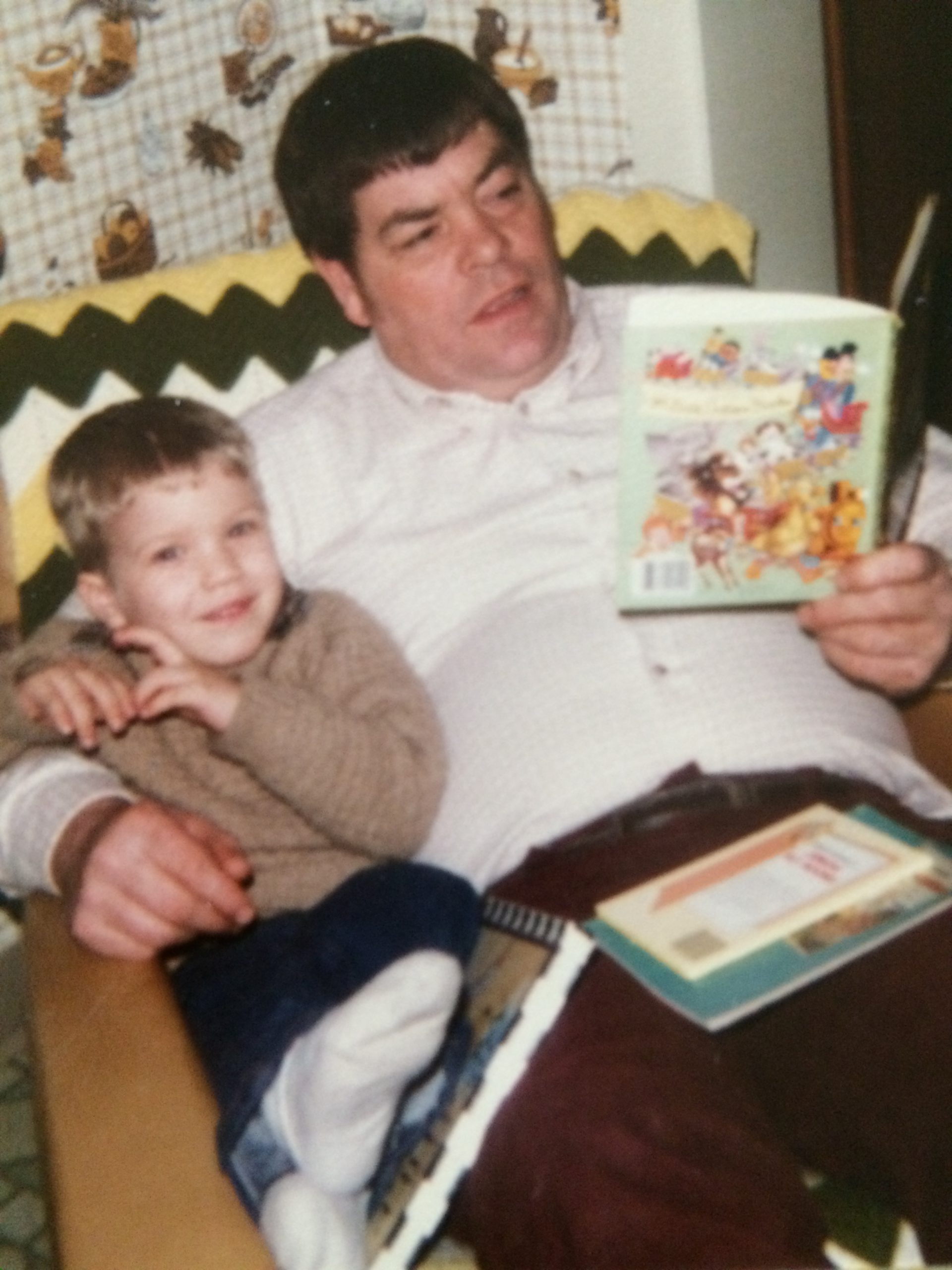
Families create traditions. This is my father reading to my son. Reading is contagious.
Sometimes a trip down memory lane is a good thing. I’ve been thinking lately about how full my life has been and how my children probably don’t know the half of my story. Funny when you stop to think about it. We are always so darn busy living that we don’t tend to take time for the stories. I tried to think of things to discuss with my dad before he died, but now that he’s gone, I seem to have questions all the time. It’s in the details. I know he rode his bike to the neighbors before school to work, but what did he do? I know he planted trees during WWII, but where are they? When did he first tap trees and make maple syrup? Where did he find the courage to buy a business when he had three young kids and a fourth on the way?
I have been blessed with curiosity piqued at an early age by books, the first of which I remember reading out loud all by myself was Hop on Pop. I remember where I was (my aunt’s) what the occasion (my 4th birthday) and the thrill of reading to everyone. That book did not survive the number of times it was read.
Thanks goodness we have a mom that was a reader. I remember going to the library weekly and coming home with an armful of books and devouring each and every one. I lived through them, going to places I never dreamed that I could ever visit. I learned about fjords in our elementary science class. They fascinated me, probably because they were related to rocks and geology, which still interests me. I remember seeing fjords on my first trip to Norway and thinking about what a long way I’d come from Mrs. Hughes third grade science class.
That love for reading naturally led to a love for writing. In fact, I won a contest for writing my own version of the Christmas story when I was six years old. My dad’s company sponsored it — he was the equivalent of a Greyhound bus driver when he was in his 20s. Mom gave me the framed copy of it a few years ago. Definitely a hoot. As an adult, I realize that I was probably the only kid that entered, but it was still a thrill.
Fast forward to college when all that reading and writing led me to a means of putting a roof over my head while taking advantage of the GI Bill. While attending Western Michigan University, I worked as a stringer for the Kalamazoo Gazette and I was also a reporter and daily Morning Edition news reader for WMUK, the local NPR affiliate. That was 1984. It was the year the Tigers won the World Series — so much fun to announce their progress on a daily basis! Here’s a daily report I did from “way back then.” It’s kind of fun to listen to and see how much has changed.
That year was also the first time I went to Camp Grayling as a Lieutenant in the National Guard. Before heading north with our convoy, I worked out a deal with Tony Griffin, my boss at WMUK and a real mentor to me. Tony had served in the Army in Vietnam and had even surfed there! Better yet, he knew the news industry and was a leader in it. When offered a position to work at the state bureau, he declined to stay in Kalamazoo with his family. The man who took the job is now NPRs National Political Correspondent, Don Gonyea. Tony was loyal and smart. One of those people who touch your life and you don’t ever forget. He pushed to get the best out of me. He cared about my future and I often find myself thinking of the lessons I learned there.
Anyhow, the deal was, I would write a story every day for the first week at Camp. I would call it in and they would play it during All Things Considered. This took some doing as I had a platoon to lead, but my company commander allowed me the time necessary to do it. I researched, wrote, and went to the payphone and called my stories in. I enjoyed that gig and made a cassette tape of the stories, then misplaced it for 30+ years. It surfaced a couple months ago and Tom Totzke performed his magic and digitized the recordings for me. I share that week of stories from the summer of 1984 here with you. I hope you enjoy this little morsel from my history and history in general. You never know where books and curiosity will take you! (click on each title to listen). 1 The Convoy 2 Michigan’s National Guard 3 Women in the Guard 4 Feeding an Army 5 The Kirtland Warbler 6 Work Hard, Play Hard 7 Touring Russian Equipment
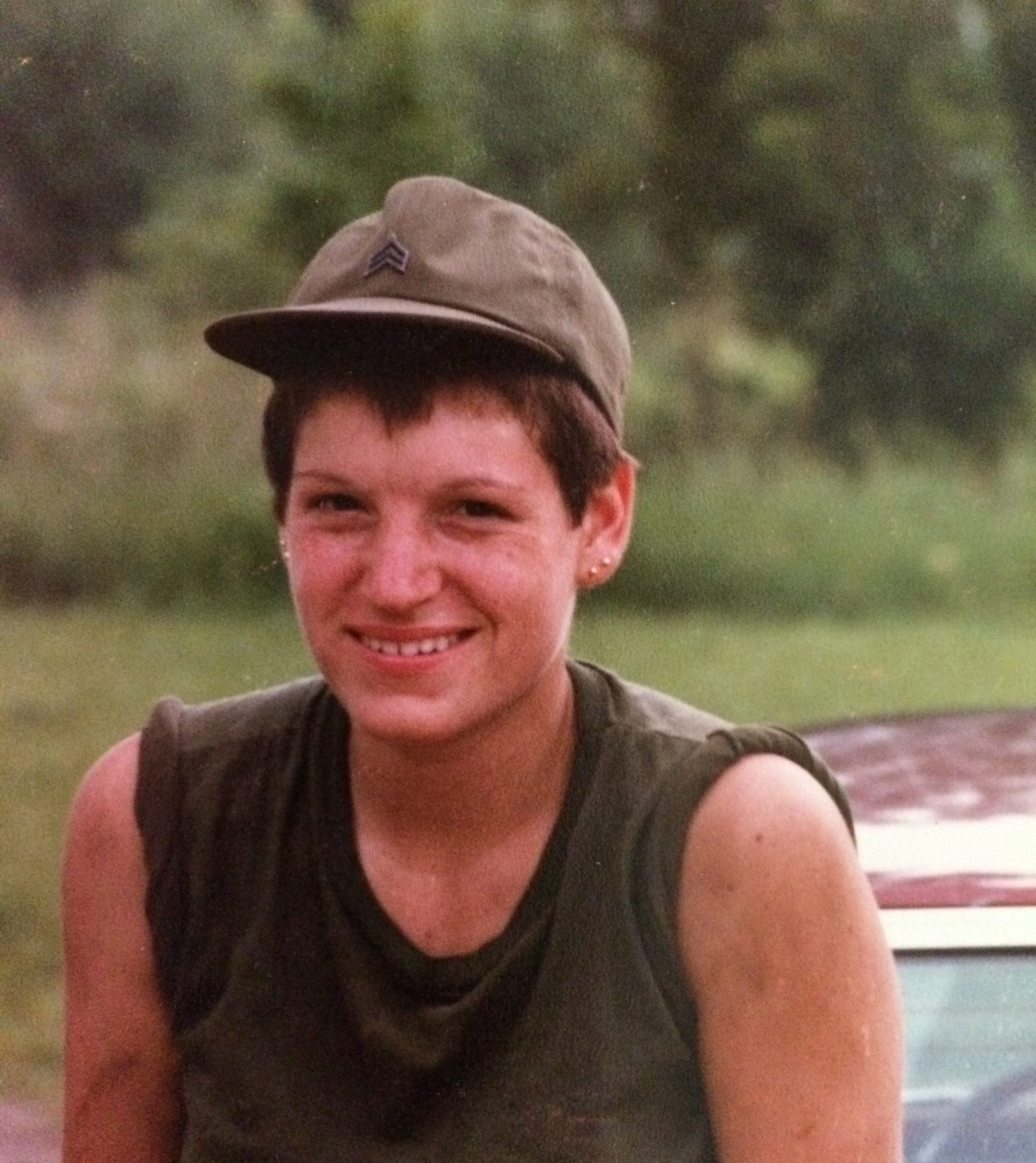
This photo was taken a year or so prior to my reporting days. I was definitely in the field getting dirty. I was a 36C as an enlisted person. We laid and hung telephone lines, back in the days prior to cell phones. It was hot, sweaty work in the field and no one bothered us as long as the job got done. The perfect enlisted job, in our eyes.
Writing and reading have continued to be a big part of my life. From creating curriculum for crafters to writing magazine articles, blogging, and writing our company newsletter, my pen gets plenty of use. Sometimes I do still use a pen and paper, but my latest gizmo is a ReMarkable digital writing tablet that keeps all my notes in one place rather than 20 notebooks scattered around the house and the shop. There’s something to be said for letting the words come out of a pen rather than out of your fingertips.
For me, no day is complete without having spent time reading — both for work and escape. Where has a book taken you lately? I would love to learn your book recommendations in the comments, including why you liked them.
It has been a year since I wrote a blog post. It has been a year of reinventing my business and a bit of reinventing me. I am learning to teach in a new way. I have been deciding what our business should look like at it’s best. I have spent time with Finn (my adorable Miniature Australian Shepherd), thinking about raising dogs and kids and the intersection thereof. I’ve been outside more. And inside my head more. This pandemic has caused much change in so many ways. Winners bend but don’t break. They learn to move with the waves and not simply ride out the storm, but be better for it. As we have seen in the Olympics, sometimes winning means letting go for long-term health.
This year I “let go” of Knit Michigan. I co-founded the non-profit that serves cancer patients in 2006 and remained it’s president and executive director until this spring. I knew it was time to pass the hat, bring in new blood and allow the organization to be revitalized. Under the guiding hands of Sam and Mike (owners of the Yarn Stop in Clawson), this is happening. It was exactly the right thing to do. This year has become a transition year as I serve in an advisory capacity as immediate past-president. Already things are getting done that will make Knit Michigan an even more vibrant organization for years to come. Knit Michigan solicits, gathers and distributes hand-crafted comfort items for cancer patients, such as chemo caps, various types of pillows, blankets and breast prostheses. Read about it and how you can help at knitmichigan.org.
Finn came to me almost exactly a year ago, just as my cancer treatment was ending and I was starting to get energy back. He was nearly five months old, a bundle of energy, and a joyful distraction as the first Covid restrictions were being lifted. A beautiful dog with a heart bigger than his body, he needed additional training to be able to come to the shop and be around customers.
On our walks, Finn has learned that he can stop and smell the flowers when I stop and photograph the flowers. He always sits patiently when the camera comes out. Quite amazing, really. We are currently working on his AKC Canine Good Citizenship certificate which is requiring a LOT of work. It is exactly what we both need. Obedience classes are really to train the human. The dogs catch on pretty quickly.
I think that is what kids are good at, too. To train the parents. I recently had my grandkids, age 10 and 13, for a week. They reminded me so much of raising my children. My father told my husband that I raised myself. Not in a bad way, but in a single-minded way. I knew what I wanted. I wasn’t a bad kid, but I know it was a challenge to be my parent.
So, what does all this have to do with reinvention. Well, teaching adults has similarities with raising children, training dogs and growing up. All in a good way, mind you! These are all puzzles to be figured out. Learning should be fun, effective, energizing, skill-building and thought provoking. I need to be clear with Finn or we won’t reach our goal. Children need to understand what the boundaries and expectations are. Adults are more challenging than pets or kids. They often have bad habits and preconceptions that they bring to the table with them.
I remember a learning situation in boot camp. The range officers preferred having females on the range because they seldom had prior experience with rifles and 45 caliber hand guns. We were a clean slate, ready to receive knowledge. The men, on the other hand, seldom had a clean slate — or wouldn’t admit to it if they did — and were more resistant to receiving new information. I think of this situation often when I meet resistance in classes. Flipping that one switch can make all the difference in the world.
To this day, educators rely on the VARK model: visual, auditory, reading/writing, and kinesthetic (hands on) learning styles. When I design classes I always take these styles into consideration. Most people learn using a combination of all these styles, but most have one style that is dominant. Figuring this out in classes by observing students is imperative. Figuring it out long-distance via Zoom puts everything into a different orbit.
Our new video studio
In October, 2020, I learned that we had received a grant through the National Mainstreet Program from The Hartford, called the Hartbeat of Mainstreet Grant. We were one of only 67 companies in the US to receive the funding that was intended to help companies survive the brutal economic effects of the pandemic. Our projects were to build a video studio at the shop to deliver content for classes over the internet and to recreate our webstore and take it to the next level. Either one alone would have been a tall order, but both together has been an immense and time-consuming undertaking.
Since receiving the equipment for our studio, we have made educational videos for public consumption (see my YouTube channel here) and videos to support our classes (both online and in the shop). So far, we have made entire video sets for our introductory weaving class THREE times. We are getting better at the process, but there is definitely a learning curve. The next big step will be going from a simple Windows editing program to Adobe’s Premiere Pro. That will take total immersion to figure it out — it is similar to learning a new language. I know what I want to do, but figuring out what it is called is an entirely different matter!
I am very, very pleased with the impact using prepared video has in our classes. The Michigan League of Handweavers (MLH) really stretched me when they switched to a Zoom conference format from an in-person format. I was challenged to teach two loom-based classes remotely. Oh boy! Hyperventilating time, for sure. But, once I stepped back, broke it down into smaller pieces, we did it! Not only was teaching successful that way, I enjoyed it and the students did, too. There’s something to be said about working at home, on your own equipment, in your own comfy chair and sleeping in your own bed at night. The Learn to Weave class was so well received, that I have been asked to teach it again for MLH in an effort to encourage to new weavers to join the craft.
Our new J&S Shetland wool
Bringing a modern webstore on-line has forced me to examine our stock. What do we do well? What do you come to us for? What suits the brick and mortar store as well as the webstore? Lots of soul searching. Where I ended up is that we do best with family and traditional yarns. The kind of yarns that tie families together and you use to create heirlooms. So, you will see more of them. We are not the store to come to when searching for bulky or super-bulky yarns or yarn that you will make a trendy sweater from. That just isn’t us. You can come to us for the staples in garment quantities. You can also find help to support patterns like that.
We specialize in what we like to call North Sea yarns. Those that come from Shetland and Norway. We now have 325 different choices in Shetland jumper weight yarn–the kind of yarn traditionally used for Fair Isle knitting. We are expanding our Rauma Norwegian line of Finullgarn as well. I also ordered much more Berroco Vintage in multiple weights to beef up our “family” yarn. Vintage is a favorite because it washes, wears, and knits well thanks to a partial wool content. Changes like this don’t happen overnight, but slowly you will see shifts in our stocking. Meanwhile, the Sale Bin is an exciting place to visit!
A happier me
I haven’t really reinvented me, but I have come to honor myself more. After 21 years of owning a yarn shop and never having knit a sweater for myself because I wanted to lose weight, I cast on a sweater for myself. Nearly 400 stitches around on size 3 needles, I’m almost to the underarms. I decided that I deserved to have a sweater and now was the time. This coincided with wrapping my head around being the on-camera instructor for our videos. Now, that was not easy. Not one bit. I wish I was at my fighting weight, but I’m not. However, that doesn’t mean I don’t have good stuff to share. Do you know how odd it is to edit yourself on the screen? To watch yourself for hours on end? Really weird! With so many screen hours, I had to get over me!
What’s next?
Over the next weeks, we will be focusing on our webstore and should have it live in September. What a relief that will be! Something I have looked forward to for 20 years. As we gain experience, our videos will come along in quality. Already, our sound is better and camera work more precise. Our content is good, as our YouTube numbers confirm.
Covid has provided opportunities to learn and grow. It forced us to look at the core of our business and exploit what we do best: family and traditional yarns, exceptional instruction, and sharing the love of our arts. We hope to be here to serve you for many years to come and appreciate your 21 years of support.
I was recently asked about my process for choosing and placing colors for stranded knitting. It got me thinking about many of the aspects of color. How does one put into words what seems such an innate thing to me? How do you communicate color decisions? It is like describing a smell, in a way. Everyone sees colors in their own way. Color even has its own language: value, intensity, hue, shades, tints, etc.
Some people react violently to color. I once painted my dining room a lovely inside-of-a-pumpkin orange. It felt warm and inviting to me. My daughter, on the other hand, reacted violently to the color and we repainted the room a cool periwinkle. Like my daughter, a friend responds physically (in a bad way) to some blues. Fast food restaurants and casinos often decorate with red because they stimulate (eat more food, gamble more). Blue is considered a calming color for many people and is the most common color across cultures. Color can be a sensitive issue.
I plan yarn purchases for the shop around an imaginary color wheel populated by my friends. Friends that favor blue/violet, blue, red, pink, orange, etc. By selecting colors for “them,” I end up with colors for everyone and no one is left out.
Over the years, I have learned that I simply love color, or in truth, color in good light. Lighting is everything. I suppose that is the photographer coming out of me. I don’t have a “favorite” color.
The two types of fiber work I do most often tend to require careful color coordination: Fair Isle knitting (click here to view my patterns on Ravelry) and band weaving, especially turned krokbragd on the inkle loom (click here for my video). Band weaving usually requires high contrast to emphasize pattern. Fair Isle knitting uses color more subtly, often incorporating three shades of one color to create the image and three shades of another color to act as a canvas or background. It is a subtle dance to get the colors to work in harmony, to ensure that values play well together.
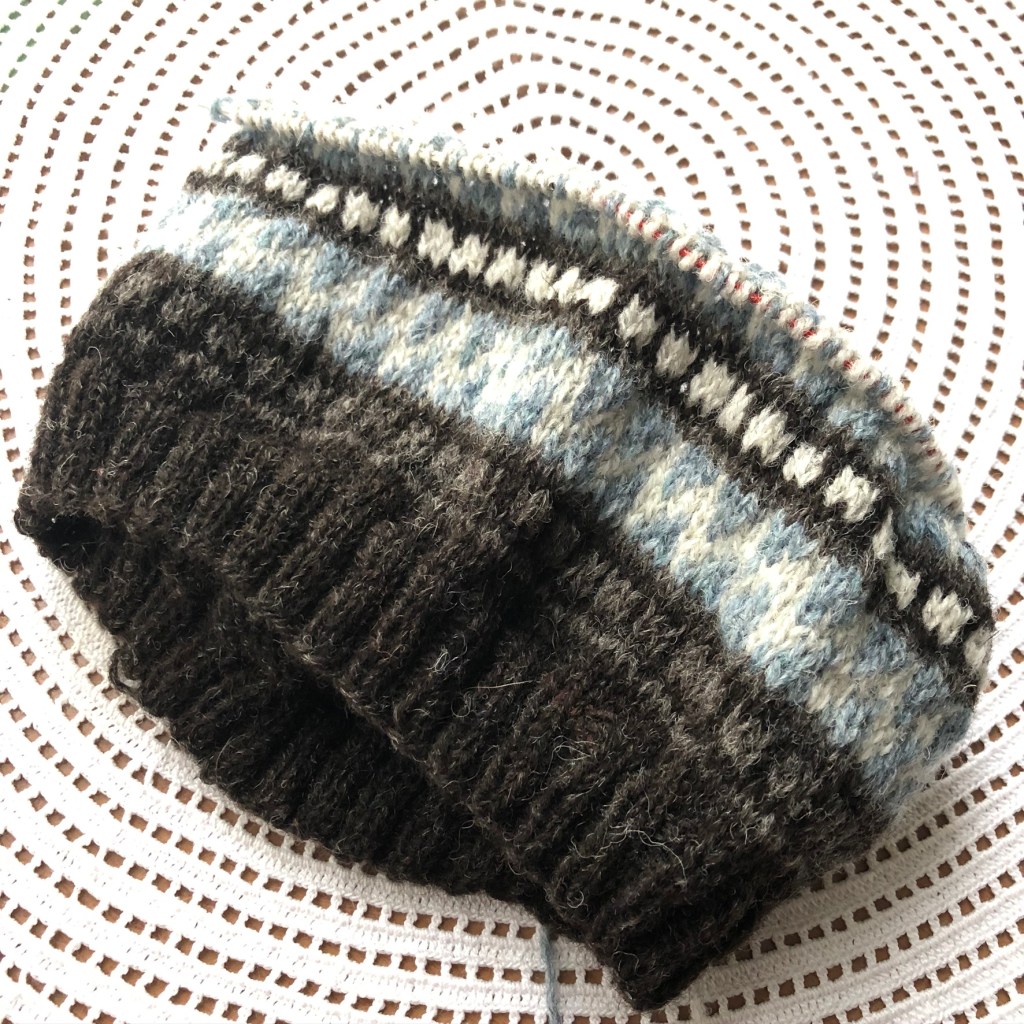
The beginnings of a new hat.
A few days ago, I decided to go to a local concert in the park and I needed a new knitting project. For me this often means a new hat design. I found my stash of Spindrift Shetland yarn and started matching up colors. In this case, I let the colors speak to me. I was drawn to the very subtle colors of Shetland black, a medium dark gray, ash, and a dusty soft blue. My plan is for a simple hat suitable for men, women and difficult to please teens. Not too fussy, but handsome. Using only four colors will be a fun challenge. I have knit a lot of hats over the years and my carefully curated stash (LOL) could fill a bushel basket. The colors all have something in common: me. I knew I could quickly pull colors together (see photo at top) and find something that pleased me.
The inspiration …The yet-to-be-published hat.
Other times when I am selecting colors and patterns, I look to nature. This yet-to-be published hat was inspired by nature. I took a photo of native campanula on Isle Royale last fall and the colors and the motif set my design radar off. This hat is where that inspiration led.
Sometimes history inspires me. My Molly Dog hat was inspired by a motif on a geometric coverlet in the collection of the Henry Ford Museum where I volunteer. The colors were selected in the early days of COVID. My mood was subdued and I needed gentle colors.
My hats designed for events, for example, are driven by the motifs. The Michigan Fiber Festival series celebrates Michigan and the motifs selected tend to dictate the color selection. A free pattern that I designed for ChiaoGoo incorporates knitting and traditional Fair Isle motifs with a twist. The ChiaoGoo hat pattern can be found here.
When designing hats that more closely adhere to traditional Fair Isle patterns, I thumb through myriad books until something catches my eye. Then I go to the computer and play with the pattern in color (I use Excel). From there I pull colors and lay them on the table under full-spectrum lighting. Every pattern calls — yearns– for a different solution, evokes an emotion, sets a scene.
Turned Krokbragd on the Inkle inspired by antique floor tiles
When designing a recent turned krokbragd band, I looked down. A tile floor from a Colorado bank built in the early 20th century became my inspiration. Selecting colors was the easy part, but figuring out how to interpret the design in textiles took a little more thought.
A tiny woven landscape.
Bands can be woven relatively quickly and color choices can range from traditional Scandinavian to modern. The pattern itself can be traditional or not. I enjoy creating miniature landscapes using the turned krokbragd technique and color is used to set the mood.
Working with color is a life-long adventure that never gets boring or dull. Whether it is on my needles, woven on my looms or behind the lens, the play of light and color is infinitely fascinating.
Sunrise on Lake Orion. A little island that looks so alone, but is surrounded by thousands of people, just a lifting of fog and sunlight away.
We are all living insular lives. I live alone and the shop is a short eight-minute walk from home. It makes it easy to move between the two and easily maintain “the distance” and keep the business alive and vibrant. My world, like yours, is a very small world.
On a typical day, I usually eat breakfast at work somewhere between 7 and 9 while checking email, Facebook, Instagram and checking to see if it’s my turn to play Scrabble—an 11-year daily habit with Sybil. If we have orders via the website, invoices are printed, product gathered and prepared for shipping. If we have Second Chance orders from our Heritage Specials group on our fb page, I hand write a list, make piles for each purchaser and get that in the shipping queue. It seems so simple written in just two sentences, but it is usually not until about 2:00 when Lika or her sub comes to get the mail that we come up for air. The USPS has become our lifeblood, carrying orders out to you and sometimes bringing new product to us.
I also get email requests, like: “I’d like to make the Nightshift Cowl, can you please find Crazy yarn and a matching solid?” So I pick several options, send photographs and, if we are lucky, I hit it the first time. If not, we do it again. Or, “I need to make five pairs of mittens for Christmas, plus a pair for me. Can you choose colors?” Sometimes more guidance is needed and the emails can go on for a day or three. Thank goodness for the phone camera and our little portable photo studio. I take pictures and send them along and decisions are made. Similar requests come in over the phone and we wander around the store finding just the right yarn for your next project. It’s kind of like being a personal yarn shopper and a detective, all in one.
DebH works as a necessary (VERY) employee three days a week. She is my sanity. Some days it takes us until early afternoon to get the orders processed. Lunchtime comes at about 2. Where we often ordered out in the past, we carry in these days. Deb stays until about 4 (or 5 or 6) and I usually go home a bit after that, except on days when I am sent home to take a nap (I’m working seven days a week).
In between, we sanitize everything, manage porch pick ups, try to keep our work areas tidy, price Second Chance, take inventory, keep the webstore up to date, take photos for Second Chance on-line, apply for grants, design patterns, shelve yarn from all the personal shopping, place orders, and try to stay sane. Deb has managed to keep up with taking the garbage out, but neither of us have tackled sweeping the floor. There will be one big cleaning work-bee before we reopen to the public! I never, ever imagined how much work it would be to run this place with just two people, really 1.5 people on a full-time basis. I am more grateful for our regular staff than I have ever been and I miss them dearly.
Our kits have been very popular since we put them on the website. They remove decision making for the knitter and are ready to knit right out of the bag. Keeping up with making the kits and yarn packs has been carefully coordinated by Becky. She lives close enough to walk to the shop, we basically do porch pick ups and she is keeping the kit shelves stocked. Sharon is also working long-distance. She is responsible for many of the Facebook posts that you see. Having help with social media has been a God-send. It has freed a bit more time for me to do other things, although I am still out there regularly, I have been able to back off a bit. Sharon’s posts help remind the world that we do have these kits, so Sharon and Becky have a somewhat symbiotic relationship!
Now, the phone rings more often and conversations are longer. I have had delightful conversations with people, mostly women, around the country. I listen, you listen, together we help save each other’s sanity. Knitting, weaving and all the fiber arts are enormously comforting.
Financially, I can guarantee you that the shop IS here and WILL be here when we are through all this. I no longer take a paycheck, but am able to pay Deb and meet our expenses. If worry produced income, this place would be flooded with gold! We will be here because of you, the community we have built and your very, very generous support. This is NOT how I intended to celebrate our 20th year in business, perhaps we will celebrate our 21st as a coming of age party. By then there should be a vaccine and freedom of movement will return, for which we will all be grateful.
Life isn’t all work. Life has layers.
One week after I closed the the shop to the public and the day the governor sent us all home, I learned that I had breast cancer (minor, small, contained, early stage, NOT critical, but still bothersome). Treatment is a simple lumpectomy followed by radiation. Since this is an elective procedure, I wait. I am president of a charity the provides comfort items to cancer patients, Knit Michigan. I know the drill, that I shouldn’t worry, but sometimes, some days, it still feels like there’s a little time-bomb in my body. So I work harder.
Our last family portrait.
Last week was the first anniversary of my father’s death. I miss him everyday and see him each time I look in the mirror. I am his daughter. The hardest part of that day was not being able to travel north to be with my family. I moved to Detroit in 1981 to attend CCS and never left SE Michigan. This will be the longest I have gone without going “home” in all these 40 years. We are a close family. Lately, they know that the business, my health, and my husband’s health (he was transferred for work to Harbor Springs over a year ago) have been weighing heavily and we talk and text often. The gift of family.
Then there’s my extended family. After a long day at work, I go home to catch up with friends that need checked in on, that I need to talk to, to those I need to hear their voice. They call or I call. In between and during our calls, I knit and continue my pattern design work. I find that I am spending so many hours keeping the shop afloat that weaving and reading do not come easily anymore. I know that I will be “better” when these once joyful activities return to my daily life.
This is Joy. Delivering JOY!
In spite of everything, finding joy has been a gift. My grandmother once told my father that “every day is a beautiful day.” She was so right. I have been making a point to look for it. A friend did some grocery shopping for me and she brought me mini daffodils. A precious gift. We have had some splendid sunrises these last few weeks. The maples are in flower. The birds are back and noisy. I enjoyed a birthday car party past a friend’s house. People are busy helping strangers by making face masks. There is a constant parade of dogs on the Village streets. One of the grants I wrote paid off: we received an advertising grant from Long Thread Media (you’ll hear more about this). I hope you find as much joy in finding joy each day as I do. It does help.
When it is over.
We will be changed. We will be different people living in the same skin. As a business owner, it really won’t be over when it is “over” because we will still have to recover financially from the loss of sales, lowering of inventory that needs restocked, and returning to being able to draw a salary. One thing I know for absolute certain sure is that my family and my Heritage family will sustain me.
Our Heritage family is so special and so far-flung, yet closer now. Today we will have a ZOOM session for our regular Sunday afternoon social knitting for Fair Isle and Norwegian knitters. We are likely to have special visitors from out-of-state that love us from afar. Thanks to all of you for being a special part of our Heritage fiber family. I hope it means as much to you as it does to us.
Shop greenhippogifts.com, one of our downtown lake orion businesses. Need masks? call Ed’s Broadway. Need chocolate? Check out Nutz about Chocolate. Sara’s Bath Boutique has soap and hand sanitizer. All have Facebook pages and websites. Visit downtownlakeorion.org for a complete list of downtownshops offering curbside delivery.
I hope my blog post has given you insight into the story of a small business owner during these unusual times. It’s not just yarn shops going through this. Every shop owner I know is struggling to do everything they can to keep their noses above water. I don’t hear complaints from them (perhaps frustration about grants promised that will not be delivered, but that really wasn’t a surprise). I do hear hope and see innovation, creativity and love for what they do. I do sense worry below the surface, because, well, we worry a lot. Please know that supporting small businesses supports our communities. Thank you for your patronage on behalf of all small businesses owners.
On the left the blended roving. On the right, yarn made from stripped roving that shows the gradations from dyeing.
When I learned to spin over 20 years ago, I spun every day. I learned that if I spun before bedtime, it would reduce my bedtime reading from chapters to just a few pages. It relaxed me that much. Over the years, my spinning time has been reduced and filled with knitting and weaving and business. The other night I was sitting trying to read a book and not succeeding. I just couldn’t focus. I looked up and *bingo,* there was that spinning wheel staring at me across the room.
A strip of roving that was spun to make the right sample above.
In my to-do pile was some sample spinning because we are looking at bringing Sweet Georgia yarn and spinning top into the store. Voila! I could work and relax at the same time. It was a very small sample, probably a bit over an ounce. With all my fiber prep tools at work, I had to use what I had. My hands. I stripped the roving lengthwise and made five different pieces of about equal sizes (no scale at home either). First I spun two as they came off the length of top, making a big honking knot where one ended and another began. I’ll explain the knots at the end.
Working from the same ends of the stripped roving, I pulled off bits that were about 5-6 inches long and piled them on my chair’s arm.
Then I took each pile and did the same thing again to blend them a bit more.
My version of spinning from the fold is to fold the prepared fiber and hold it between my thumb and first finger. My fingers just won’t cooperate when I try to place the fold over my index finger.
I then took the other three lengths and blended them as best I could on the arm of my chair. I did that one length at a time and then blended each stack with itself again, trying to blend as much as possible. I split the resulting fluff piles into half and spun from the fold.
The yarn on the left is from the blended preparation. It is much more heathery. Ideally, I would have liked to run it through a drum carder and spin from lengthwise strips from the batt. The yarn on the right maintains it’s color integrity better because it is spun as it is dyed and the direction of spinning and plying is carefully maintained.
The difference in the yarn is remarkable. I learned that I need more practice spinning, that spinning from the end of the stripped roving created a smoother yarn, and that I’m still not an ace at spinning from the fold. So, here I share my results with you and let you know that spinning is still a really great stress reducer and I think doctors should prescribe it for anxiety! Ahhhhh! I will be doing more spinning in the days, weeks and months ahead and I even predict that my spinning will improve.
A note about my big honking knots when spinning samples. By spinning onto the same bobbin, I save time and my spinning rhythm is maintained better. Every time I end the length of single that I will ply with it’s partner/s, I put a knot. Then, I transfer the singles from the spinning wheel bobbin to weaving bobbins using a bobbin winder. When I come to a knot, I break the yarn and stop. Get a new bobbin and continue winding off. In this case, I ended up with four weaving bobbins ready for plying. These looked so different on the bobbins, it was easy to see the pairs. Finally, I should add, that I always transfer the singles on my spinning wheel bobbins onto a spare bobbin or weaving spool and ply from those. That way, I always begin plying in the same direction as I started spinning and my finicky fingers like the way that feels.
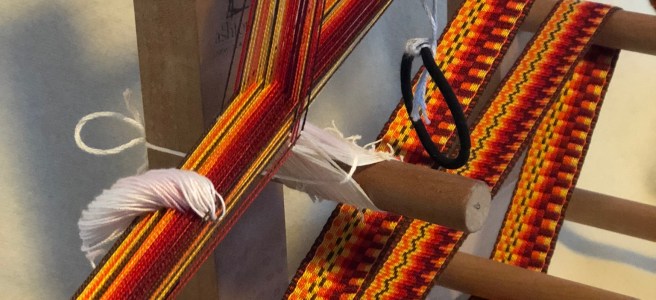
I’ve been really enjoying band weaving of late, especially weaving in the turned krokbragd style. It is loom-controlled and quite easy to set up after you understand the constraints. Loom controlled means that the thinking is in the set up and the weaving can be done at night when I’m too tired to think. Following a pattern is fairly straightforward, it is setting up new designs to be woven that take precision and accuracy. Step one is to design your pattern on a brick-like grid. Not so hard. Then, because the grid is actually representational of a 3-dimensional object and warping is done linearly (2-dimensional), a translation must be made. The threading diagram looks nothing like what the woven band will look like. It’s an amazing puzzle that I enjoy quite a lot.
In a recent band, something was lost in translation between the “brick” diagram and the threading diagram. Perhaps it had something to do with the craft beer I had with dinner, or the fact that it was quite a wide band, or I was just too tired to be doing that kind of work late in the evening, but whatever the reason, my threading diagram didn’t represent the band in my mind’s eye. I figured this out about halfway through the threading. Throwing caution to the wind, I decided to forge ahead and see what this now “unknown band” would look like. So I marched on with the threading according to my chart.
Non-traditional serendipity
It turns out that I love the band. It taught me that this weave structure doesn’t have to rely on traditional krokbragd motifs, it only needs to rely on a repetition of three. So simple, yet it is like a whole new door of possibilities opened. I can’t wait to do some purposeful designing that strays from the traditional.
Rewoven and traditional
So that I would have something to compare my accidental design to, I reworked the threading diagram to achieve the pattern I originally intended. It is decidedly in the krokbragd style. I am looking forward to marrying the restrictions of the weave structure with the possibilities it has to offer in new and different ways.
A big shout out to my friend Tom, Excel master extraordinary. Between the two of us, he managed to program a spreadsheet that can accurately assist me in converting the brick diagram to the threading diagram. What a joy it is to warp with confidence from an accurate threading diagram. Thanks, Tom!
Technical details:
Both bands have 127 threads
Non traditional: used 8/2 cotton with 8/4 cotton weft. 1 3/8″ wide
Traditional design: used #8 perle cotton in both warp and weft. 1 1/4″ wide
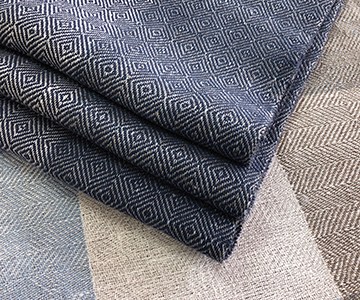
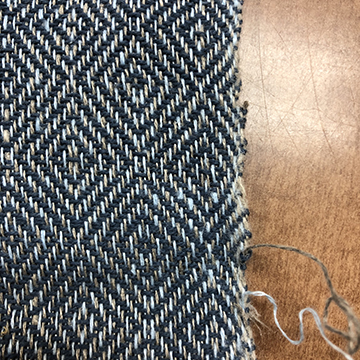
Simple is never simple. Our Jane Stafford On-Line Guild Study Group decided to do a year-end towel exchange to apply what we have learned in our own way over the past three years. I had several personal goals in mind, namely: to explore the 2-ply Lithuanian linen we carry in the shop, to weave a pattern I love (goose eye twill) and, of course, to produce towels for our exchange. Little did I know how these simple towels would challenge me.
Three towels and
one napkin.
The assignment called for a towel roughly 20” wide. To balance my pattern, my plan called for 415 ends, a width of 20.75” in the reed at a sett of 20 epi. I planned for four towels and one sample.
My (abbreviated) draft looked like this:
The first sample. Kinda squiggly.
I based my sett on earlier woven samples to arrive at a sett of 20 for a nice drapey towel (perhaps my sett samples were mislabeled?). My first sample was a gauzy fail, but I did try different yarns in the weft (from top to bottom): 8/4 Brassard cotton, the three different linen warp colors used as weft, a 6/1 Borgs tow linen, and 8/2 Brassard cotton. From this sample I decided to shoot for 24 epi and work a second sample (no photo because I have misplaced it). What it taught me was that 24 is the right sett. 8/4 weft is too heavy, the linen is stiff, and the 8/2 has a nice hand that immediately matches the intended purpose of the fabric. Based on what we learned in Jane Stafford’s on-line guild, I did not rebeam the warp. I tensioned normally, because, in theory, that little difference in width shouldn’t matter if even tension was maintained throughout the warp, which it would be.
With the sett determined, I had to figure out why I was having so much problem with my selvedges. The simple fixes weren’t working:
Wider weaver’s angle.
Advance more frequently.
Sley the floating selvedge by itself
Use a heaver thread for the floating selvedge (three-ply versus two-ply).
Change the direction of throwing the shuttle.
My next thought was about a paper written by Alice Schlein called The Selvedge Dilemma (Alice shared it on WeaveTech a number of years ago). She discussed working with the twist of the yarn to correct selvedge breakage. For my “S” plied yarn, I threw over the floating selvedges on each when passing the shuttle from left to right and under the FS on each side on the return (a circular pattern, rather than the traditional figure-eight). Changing to this method of throwing the shuttle did make things better, but it did not eliminate the problem.
Nasty selvedges are painful!
At the same time, I was having a problem with the linen breaking at the spinning joins. I remembered from a class with Nancy Hoskins, that dampening the linen by laying a damp cloth on the web behind the castle may help. After all, linen is stronger when wet. That helped tremendously. I should note that the humidity the past week in Michigan has been in the 20s. Very, very low. I continued with the damped linen tea towel throughout the entire warp, periodically adjusting it as it repositioned itself from the movement of the warp and I had no more breakage.
A damp linen towel on the web stopped the linen plies from splitting mid weave.
I was getting ½” draw in on each side. My warp was still beamed for 20. In addition to selvedge issues, I wasn’t getting clear lower sheds, even after the apron rod went over the front beam. I attributed this to the jack loom. The unevenness of the lower shed caused the shuttle to dive and sometimes to bump threads and bounce back. I was continually digging my hands into the warp to push the shuttle through. There was no way I could weave four towels under these conditions and maintain my sanity and the integrity of the warp.
Following the “suck it up buttercup” school of weaving, I cut off the second sample, pulled the warp forward and secured the dangling floating selvedges to the back apron rod, secured two pairs of miscounted warp threads, and effectively removed any messiness at the back of the loom. I then weighted each of the three warp sections using 2.5 pound weights laid on the floor and rebeamed using the reed as a raddle.
After tensioning for the third time, everything looked much nicer, even the lower shed. However, it was still looser than the upper and caused problems. The last thing left to do to fix my selvedges problem was add a temple. That did the trick. The warp became an enjoyable weave.
The next challenge was to remember the very simple pattern while weaving in public during regular shop hours. I always need to weave a bit to find the rhythm/pattern that makes sense to me. It was another “suck it up” moment when I realized I couldn’t eyeball the pattern if I wanted to get the results I intended. I would have to count. But, hey, it was only to 15. Then I found that my mind wandered or I would get distracted and forget if I was going up or down the twill and I would break the pattern. I solved that by putting a marker on the warp selvedge on the side the twill started on. It only took a hot second to place it and it saved my bacon several times. If I was weaving in solitary, that probably wouldn’t have been necessary, but it did help me and was worth the extra step.
The clip acted as a reminder as to twill direction.
Finishing was simply a machine wash, hand hem and press. I’m pleased with the end result and like the quiet, classic colors and weave.
All this thinking and testing and fretting created quite a mess!
Lessons learned:
20% humidity and linen don’t mix well without intervention.
In the future I will weave linen on one of our countermarche looms. I proved it can be done on a jack, but I think it will be easier with equal warp tension and since I have the luxury of a selection of looms, I might as well take advantage.
Count more carefully at the warping board. This is the second warp in recent memory where miscounting in the measuring contributed to problems at the loom.
Mixing cotton with linen creates a lovely fabric with benefits of each fiber.
Cotton shrinks more than linen. I should have planned for that when using the golden mean to calculate towel length. The cotton weft shrank a full 1” more than the linen weft, making my towels disproportionately long.
I will continue using Alice’s selvedge solution to honor yarn twist.
Ripping back knitting can be painful or liberating. Sometimes it is a transition from one perspective to the other. It is usually not easy to make the decision and many things can push you over the edge. Perhaps it is size — I remember a customer that was making a sweater for her husband and it was turning out big enough to fit both her and has husband — at the same time — yet she continued knitting. It will get better, she said. Denial is a powerful opponent.
Then there’s that small error in the lace pattern, “No one will notice.” Sure the scarf will still keep you warm, but will it bother you? My 3D art instructor told us that projects should look as good on the inside as the outside. Then she said, others will not see the inside, but you and God will know the difference. She had a point.
In working on a new hat design that required me to rip the crown off a fully completed hat because the color was “off,” I got to thinking that a few tips for ripping back and fixing errors might be helpful to others.
Get your head in the right place. Find the learning opportunity. I always try to fix errors if I possibly can. Lace, dropped stitches, forgotten yarn overs, whatever. Even if I don’t succeed in fixing it, I always learn more about how the yarn moves through the row and how the stitches relate to each other. That learning makes future fixes more successful.
Be prepared with the rights tools. I find bamboo needles and locking stitch markers helpful for holding stitches. A Susan Bates Knit Check tool is a must. It has a crochet hook on one end and a pointed end on the other.
If you must take your stitches fully off the needle, use a needle at least two sizes smaller to pick up the stitches again. The smaller needle will make it easier to orient the stitches and nearly eliminate split stitches. Warning — make sure to resume knitting using the correct needle size.
Set a pattern in weaving in your ends. In the crown I recently ripped out, I was very grateful that I always weave in ends on my hats in the same way. I was able to find them and tease them out — no scissors needed.
If you are working with wool or other yarns that respond well to steam, it will help stitches stay where you want them if you steam them before ripping. It will not matter that the yarn is kinked from the steam. Reknit and block and the slight irregularities from steaming will disappear.
Be brave. Learn. Make beautiful work that you will be proud of. Learn to judge for yourself when “good enough” is indeed good enough. Learn when to rip and when to fix. Learn to be kind to yourself and enjoy every part of the knitting process.












 I also get email requests, like: “I’d like to make the Nightshift Cowl, can you please find Crazy yarn and a matching solid?” So I pick several options, send photographs and, if we are lucky, I hit it the first time. If not, we do it again. Or, “I need to make five pairs of mittens for Christmas, plus a pair for me. Can you choose colors?” Sometimes more guidance is needed and the emails can go on for a day or three. Thank goodness for the phone camera and our little portable photo studio. I take pictures and send them along and decisions are made. Similar requests come in over the phone and we wander around the store finding just the right yarn for your next project. It’s kind of like being a personal yarn shopper and a detective, all in one.
 Our kits have been very popular since we put them on the website. They remove decision making for the knitter and are ready to knit right out of the bag. Keeping up with making the kits and yarn packs has been carefully coordinated by Becky. She lives close enough to walk to the shop, we basically do porch pick ups and she is keeping the kit shelves stocked. Sharon is also working long-distance. She is responsible for many of the Facebook posts that you see. Having help with social media has been a God-send. It has freed a bit more time for me to do other things, although I am still out there regularly, I have been able to back off a bit. Sharon’s posts help remind the world that we do have these kits, so Sharon and Becky have a somewhat symbiotic relationship!









 joansheridan